Italian Brainrot Extreme Driver








Italian Brainrot Extreme Driver
The first thing that surprised me about Italian Brainrot Extreme Driver is how much it punishes greed. You see a ramp, you floor it, you launch off a gravity-defying loop expecting to stick the landing like a pro, and instead your shark-on-sneakers smacks the asphalt nose-first and resets. That sting is the whole game. It looks like a goofy meme racer, and it is, but underneath the chaos there's a real stunt-and-recovery rhythm you have to learn.
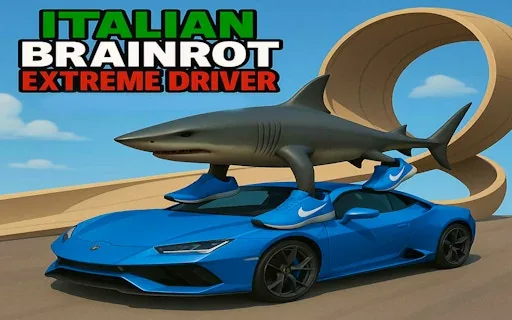
You're driving Tralalero Tralala, the blue shark wearing Nikes who became one of the most recognizable faces in the whole Italian Brainrot wave. Here he's strapped into some kind of stunt buggy, ripping around tracks that twist into corkscrews, fling you over gaps, and bend physics in ways no real road ever would. The vibe is half Hot Wheels, half fever dream.
The loop is simple to describe and tricky to actually pull off. You build speed, you hit a ramp or a loop, you manage your boost on the way up, and then you land flat enough that you don't eat a crash. Land clean, keep your momentum, chain into the next obstacle. Land sloppy and you lose all your speed, which on a long track is basically death by a thousand resets.
There's a low-key satisfaction in clearing a stretch that wrecked you ten times in a row, the kind of small win that keeps arcade games like this alive long after the shark-on-sneakers gag wears off.
What keeps it interesting is the boost. It's tempting to burn it the second you have it, but boost mid-air does nothing useful if your angle is already wrong. The skill ceiling is figuring out when speed helps and when it just turns a recoverable wobble into a faceplant.
The tracks themselves deserve a word, too. They're not laid out like a normal circuit. You get sections that spiral straight up, jumps that toss you across a gap with no clear floor on the other side, and the occasional loop that seems designed purely to disorient you mid-flight. The level designers clearly cared more about the spectacle than fairness, which means a chunk of the early difficulty is just learning what a track even wants from you. Once you've crashed a stretch two or three times, you start reading it, and that's when the runs get smooth and genuinely satisfying.
A fair warning, since we try to be straight with you on these: this is a casual browser tie-in, not the Roblox game. There's no account, no income-per-second, no stealing brainrots from other players. It's a quick-hit physics racer that borrows the meme's star. But for a free thing you can boot up in a tab, the handling has more depth than it has any right to, and the ragdoll crashes are genuinely funny the first dozen times. After a while it gets repetitive, sure. Most arcade stunt games do. It's the kind of game you play in five-minute bursts, not for an hour straight.
How to Play Italian Brainrot Extreme Driver
Controls are about as plug-and-play as it gets. Arrow keys or WASD drive, and Space handles your brake and your mid-air flip, which is the button you'll be leaning on most.
Throttle and steer
Hold up or W to accelerate, left and right to steer. On the ground that's all standard. The catch is that steering also rotates you in the air, so the same keys that turn you on a track are how you correct your angle during a jump. Get used to that overlap early because every clean landing depends on it.
The Space key is doing double duty. Tap it on the ground and it's a brake, useful for tightening a turn or scrubbing speed before a tricky ramp. Tap it in the air and your driver flips, which is how you square up a nose-down or tail-down launch before you hit the deck. Landing roughly level is the entire ballgame.
Boost usually triggers automatically as you build speed or shows up as a meter you can dump on straights. Use it on flat ground to set up a big jump, not mid-flip when you've already lost control.
Get a feel for how the buggy behaves at different speeds before you go for anything ambitious. At low speed it's stable and forgiving; push it fast and it gets twitchy, especially over uneven track. The early ramps are basically a free tutorial, so use them to learn how far a tap of the brake actually scrubs your speed and how quickly a flip rotates you. That muscle memory is everything once the tracks get nasty.
There's no tutorial holding your hand. You crash, you reset, you try the same loop again with a slightly better angle. That trial-and-error rhythm is the point, and the resets are fast enough that it never feels like a real punishment.
One thing worth internalizing early
momentum is your real score. Every clean landing that keeps your speed up feeds the next jump, so a great run is really a chain of small good decisions rather than one heroic launch. The moment you stop thinking about individual ramps and start thinking about the whole line through a track, your runs get noticeably longer and the crashes get rarer.
Strategies & Tips
Treat the brake as a steering tool
New players hold the throttle flat the entire track and wonder why they keep overshooting ramps. A quick tap of Space before a jump lets you hit the lip at a controlled speed instead of launching wild. You land softer and keep more of your momentum than a full-send ever gives you.
Fix your angle before you land, not after
The flip button only helps if you press it early. The moment you leave a ramp, look at how your driver is pitched and correct it on the way up, not in the last frame before impact. A nose pointed even slightly down turns a clean landing into a reset.
Save boost for the run-up, not the jump
It feels natural to slam boost while airborne, but extra speed mid-air mostly just makes a bad angle worse, faster. Spend it on the straight before a loop so you carry enough speed through the whole obstacle. Honestly the physics here reward setup way more than raw aggression.
Learn each loop's exit, not just its entry
A gravity-defying corkscrew can spit you out facing a wall if you took it too hot. Pay attention to where each loop drops you and adjust your entry speed so the exit lines up with the next section. Memorizing exits is what separates a smooth lap from a stutter-step crash-fest.
Build a mental line through the track
Once you've crashed a section a couple of times, stop reacting to it and start planning it. Decide where you'll brake, where you'll let it run, and where the safe landing zone is before you even reach that part. Drivers who plan the whole line instead of improvising ramp to ramp run far cleaner and recover from wobbles faster. It's the difference between a track that feels like random punishment and one you can read like a sentence, and that shift usually happens around your fourth or fifth attempt at a given stretch.
Don't chase a perfect run too hard
It's an arcade stunt racer, not a sim. Some tracks have a jump or two that just feel inconsistent, and grinding the same corner forty times will sour the whole thing. Reset, take it slightly slower, move on. The fun curdles the second it becomes a chore, and the runs you'll remember are the loose, lucky ones anyway.
Controls
🖥️ Desktop
📱 Mobile
Why Play Italian Brainrot Extreme Driver Here?
It's the rare meme game where the joke and the mechanics actually pull in the same direction. A shark in sneakers doing gravity-defying loops is funny on its own, but the fact that you genuinely get better at the landings is what makes you reload it. The crashes are quick, the tracks are short, and the handling has a real learning curve hiding under the silliness.
It also slots nicely next to the rest of the meme universe if you're already deep in it. Tralalero Tralala is one of the headliners, and once you've driven him you'll probably want to see where he ranks on the value list or poke around the other browser games built on the same characters. The fact that it asks for nothing, no sign-up, no install, no waiting, makes it the kind of thing you'll keep coming back to between other tabs. As a free, no-download tab game that you can actually get better at, it's an easy yes.
Comments (0)
Loading comments...