Merge Brainrot






Merge Brainrot
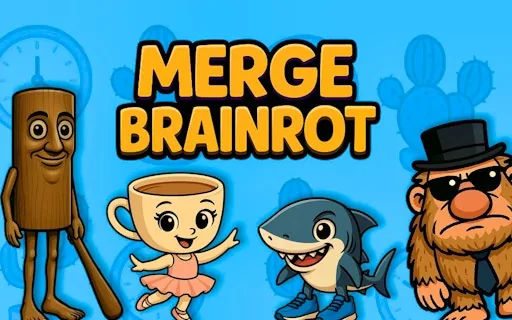
I did not expect a merge puzzle to make me laugh out loud, but every single fusion in Merge Brainrot fires off some unhinged meme audio clip, and the surprise of it never quite wears off. You drag Tralalero Tralala into another Tralalero Tralala, they pop into the next tier with a noise that has no business being that loud, and you immediately want to do it again. That little dopamine spike is the whole engine of the game.
It's a classic merge-two-to-make-one puzzle at heart, the same family as the fruit-dropping games you've probably lost an evening to. You've got a board, you drag matching brainrots together, and each pair combines into a single higher-tier creature. Common little guys fuse into rarer, weirder ones, and the goal is to keep climbing the tier ladder without choking your board with mismatched pieces.
What sets it apart from a generic merge clone is the cast and the chaos. Every tier is a recognizable face from the Italian Brainrot universe, and merging them up the ladder feels a little like building your own value list in real time. The audio is the real hook, though. Each combine triggers a different cursed clip, so the board basically becomes a soundboard you play by accident. It's gloriously stupid and it works.
That personality is the whole difference between a game you try once and one you keep open. Most merge clones are silent and interchangeable. This one has a sense of humor wired into its core verb, so every fusion gives you the mechanical payoff of progress and a dumb little audio punchline on top.
Easy to start, hard to master is the honest pitch. Anyone can drag two things together. Keeping a clean board so you always have room to make the next merge, while planning two or three tiers ahead, is where it gets genuinely tricky. Fill your space with one-off pieces you can't pair and you stall out fast.
There's a quiet collector's itch driving the whole thing, too. Each new tier you unlock is a creature you haven't seen fuse before, with its own sprite and its own ridiculous sound, so part of you keeps merging just to find out what's at the top of the ladder. It scratches the same nerve as filling out a roster, and if you already obsess over where each character sits in the meme hierarchy, watching them stack up in front of you is oddly compelling. The game never tells you how high the tiers go, which is exactly why you keep pushing for one more.
We'll be upfront
this is a casual browser game, not the Roblox title. There's no real account, no trading economy, no stealing from other players. It's a self-contained merge puzzle wearing the meme universe's skin. But for something free you can boot in a tab, the loop is properly sticky, and the audio gags give it a personality most merge games completely lack. It does get a little grindy at the high tiers, sure. They all do. The early climb is where the pure fun lives.
How to Play Merge Brainrot
If you've played any merge or drop puzzle, your hands already know this one. It's all dragging, no keyboard required.
Drag and drop
Click and hold a brainrot, drag it onto a matching one, and release to fuse them into the next tier up. That's the core verb, repeated. Two of the same tier always make one of the tier above, so you're constantly hunting for pairs and deciding where to drop new pieces.
New brainrots usually feed onto the board over time or when you trigger a spawn, so part of the game is managing where things land. Drop a fresh piece next to its match and you can chain a merge immediately. Drop it carelessly and it clogs a corner you needed.
On mobile it's the exact same idea with your finger
press, drag, release. The touch controls map cleanly because the whole game is built around one gesture, which is part of why it's such an easy pick-up-and-play.
The difficulty creeps up quietly. Early on you've got plenty of room and the merges practically make themselves, but as your higher tiers occupy more space and the commons keep flowing in, the board tightens and every placement starts to matter. There's no sudden wall, just a gradual squeeze that rewards players who kept things tidy and punishes the ones who got sloppy in the easy phase.
There's no fail timer breathing down your neck in the early going. The real pressure is space. A full board with no available merges is effectively game over, so every drop is a small decision about keeping your options open. Plan the placement, not just the match.
A helpful mental model
treat the board like a workbench, not a storage shelf. Low tiers are raw material you want flowing through and combining constantly, while your one or two highest pieces are finished work you tuck out of the way. When you stop dumping everything wherever it fits and start sorting by tier, the chaos calms down and your runs get a lot longer. It sounds fussy, but it becomes second nature within a few games.
Strategies & Tips
Keep your board breathing
The single biggest mistake is filling every slot with high-tier pieces you can't pair yet. Leave open space so incoming brainrots always have somewhere to land near a match. A cramped board with no legal merges is how most runs die, so treat empty space as a resource you're protecting.
Merge up from the corners
Anchor your biggest, highest-tier brainrot in a corner and build toward it, keeping your smaller fusions flowing in from the open middle. That way your near-complete tiers stay out of the way instead of blocking the spots where you're doing the fast common merges.
Don't chase every rare immediately
It's tempting to force two mid-tier pieces together the instant you can, but if it leaves three orphaned commons stranded, you've made your board worse. Sometimes the right move is to hold and finish the low-tier cleanup first. Patience beats greed here more often than you'd think.
Think two merges ahead
A single fusion is easy. The skill is setting up so that the piece you create immediately has its own match waiting. Before you combine, glance at whether the result will pair with something already on the board, and you'll start chaining merges instead of making isolated ones. Chains are where the board suddenly opens back up, three or four fusions firing off one after another, clearing a cramped mess into breathing room in a couple of seconds.
Set up a dedicated merge lane
Pick one row or edge of the board and use it purely for combining commons, feeding fresh pieces in from one side and letting the results graduate toward your high-tier corner. Keeping the chaos contained to one lane stops your low-tier cleanup from accidentally walling off the space you need for bigger pieces. It's a small habit that pays off enormously on a crowded board, and once it becomes automatic you'll wonder how you ever played without it.
Let the audio be a reward, not a distraction
Every combine fires a meme clip, and yeah, it's hilarious, but don't let it pull your eyes off the board state. If you want the full soundtrack on demand, the soundboard has the clips on tap. In-game, treat each noise as confirmation a merge landed and keep planning the next one rather than waiting around to enjoy it.
Controls
🖥️ Desktop
📱 Mobile
Why Play Merge Brainrot Here?
Merge puzzles are quietly some of the stickiest games out there, and bolting the Italian Brainrot cast plus a wall of cursed audio onto that formula is a genuinely inspired combo. The drag-to-fuse loop is satisfying on its own, but the noise each merge makes turns a calm puzzle into something you keep playing partly just to hear what happens next. It's the rare puzzle game with a sense of humor baked into its mechanics rather than bolted on the side.
Climbing the tiers also doubles as a fun crash course in the meme hierarchy, almost like assembling your own value list one fusion at a time. If the characters hook you, the full roster and their stats live on the brainrots database. It's free, it's instant, and it's exactly the kind of one-more-merge game that quietly eats a lunch break before you've noticed the clock.
Comments (0)
Loading comments...