Slope Rider














Slope Rider
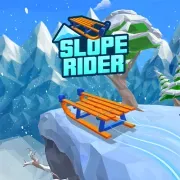
Slope with a sled. Somehow harder. If you thought steering a frictionless ball down a neon slope was stressful, wait until you add vehicle physics, lean mechanics, and a sled that fishtails every time you overcorrect. Slope Rider takes a formula that already had most players wiping out before the 60-second mark and layers on extra complexity that makes survival feel like an achievement worth bragging about.
The difference between a ball and a sled sounds trivial. It is not. A ball has a single point of contact with the ground, so it responds instantly to directional input. A sled has a base — width, weight distribution, momentum. When you steer left, the sled does not instantly go left. It leans, shifts weight, and gradually turns. Overcorrect and the back end swings out. Overcorrect the overcorrection and you are spinning sideways at terminal velocity into a wall. The physics create a completely different skill profile from standard Slope, even though the visual setup looks nearly identical.
The lean mechanic is the key addition. Pressing up tilts the sled forward, increasing speed at the cost of stability. Pressing down leans back, slowing you but giving more control. Finding the balance point — fast enough to maintain a competitive pace, stable enough not to cartwheel off the track — is the entire game. New players lean too far forward and crash within seconds. Cautious players lean back and move so slowly that they never hit impressive scores. The sweet spot is narrow, and it shifts as the slope geometry changes.
With 4.5 million plays, Slope Rider has found its audience among players who loved the original Slope formula but wanted something with more mechanical depth. The sled physics reward practice in a way that the original Slope (which is more reaction-based) does not always match. Getting better at Slope Rider feels tangible — your body learns the lean timing, your fingers develop muscle memory for the correction patterns, and your high score creeps up in consistent, measurable increments.
How to Play Slope Rider
Left and right arrow keys (or A and D) steer the sled laterally on the slope. Up arrow leans the sled forward, increasing downhill speed. Down arrow leans back, braking slightly. The sled accelerates automatically over time, just like in Slope, but the lean mechanic gives you partial speed control that the original game does not offer.
The slope generates infinitely ahead of you — no two runs are identical. Obstacles include red blocks, gaps in the track, narrow passages, and sharp curves. Standard Slope stuff. But the sled physics change how you approach each obstacle. In Slope, you tap left or right and the ball moves instantly. In Slope Rider, you tap left and the sled begins a lateral shift that takes a fraction of a second to complete. That delay means you need to start dodging earlier, which means you need to see obstacles earlier, which means you need to look further ahead on the slope.
Coins appear along the track and serve as both score multipliers and a risk-reward mechanic. Most coins are placed slightly off the optimal line — grabbing them requires a small detour that might put you in a worse position for the next obstacle. Experienced players learn which coin placements are safe to grab and which are traps that lead to crashes.
On mobile, tilt controls replace arrow keys. Tilting the phone left and right steers the sled, and tilting forward or back controls the lean. Some players swear that tilt controls feel more natural for a sled game than keys. Others find the lack of precise digital input frustrating. Try both and see which clicks for you.
Strategies & Tips
Lean management is the core skill. The default should be a very slight forward lean — enough to maintain speed without sacrificing control. Only increase the forward lean on straight, obstacle-free sections where the speed boost will not get you killed. Pull back to neutral or slight backward lean before any turn, gap, or obstacle cluster. Think of it like braking before a corner in a racing game. The sled handles turns dramatically better at moderate speed than at maximum speed.
Countersteering is the technique that separates high scorers from everyone else. When you steer hard in one direction and the sled starts to swing, a tiny tap in the opposite direction arrests the swing. Do not hold the opposite key — just tap. A held countersteer turns into an overcorrection, which causes a swing in the other direction, which requires another countersteer, and suddenly you are oscillating wildly down the slope. Tap. Brief. Controlled. Let the sled settle, then make your next input.
Speed management through lean is most important at two moments: entering tight passages and approaching gaps. For tight passages, lean back slightly to slow down — the extra half-second of control lets you thread the needle without clipping the walls. For gaps, lean forward slightly to increase your jump distance off the edge. Yes, the sled catches air when it hits a gap. A forward lean makes you travel further through the air, clearing wider gaps. A backward lean drops you short. Getting the lean angle right for each gap width is a learned skill.
The obstacle patterns have a rhythm. Play enough runs and you start recognizing sequences — three staggered blocks usually follow a specific curve type, narrow passages tend to appear after gap sections. This is not truly random. The procedural generator follows rules, and experienced players learn those rules subconsciously. Your "instinct" for what is coming next is actually pattern recognition built through repetition.
Why Play Slope Rider Here?
If you have maxed out your Slope skills and want a fresh challenge with the same DNA, Slope Rider is the natural next step. The sled physics add depth without abandoning the simplicity that makes slope runners addictive. Free in your browser, no downloads, no accounts. Play it right here alongside 30+ other games.
Comments (0)
Loading comments...